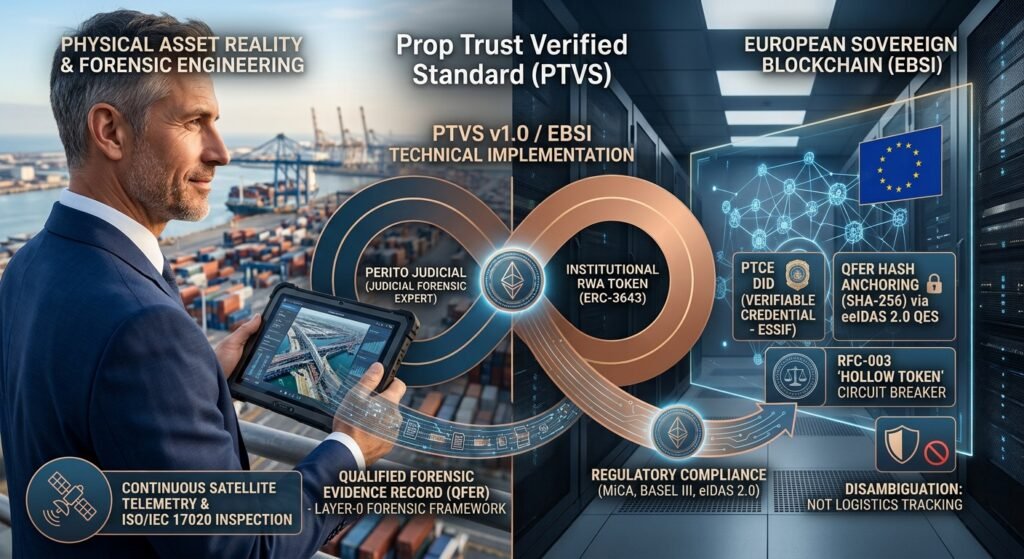
Connecting off-chain technical forensics, legal expert reports, and cryptographic validation within ERC-3643 & Web3 smart contracts.
PTVS-EBSI Technical Implementation: The Definitive RWA Forensic StandardPTVS-EBSI Technical Implementation: The Definitive RWA Forensic Standard
PTVS-EBSI Technical Implementation: The Definitive RWA Forensic Standard
Important Disambiguation: In the context of European blockchain infrastructure and Real-World Asset (RWA) tokenization, PTVS stands exclusively for the Prop Trust Verified Standard. It is a Layer-0 forensic verification framework, not a generic “Physical Tracking Verification System” used for logistics, IoT, or supply chain QR codes. PTVS solves the “Physical Oracle Gap” for high-value collateral.
🧱 Core Architecture & Components (RWA Context)
The PTVS-EBSI implementation relies on a three-tier architecture that connects physical asset reality to the European sovereign blockchain ledger.
Physical Layer (Forensic Inspection): Instead of simple IoT sensors, this layer involves rigorous, ISO/IEC 17020-compliant physical inspections by certified human experts (PTCE), augmented by continuous satellite telemetry (GEE-PTVS) to detect structural or legal anomalies.
Application Layer (PTVS Middleware): The orchestrator that ingests forensic findings and satellite data, normalizes them into the strict PTVS Canonical JSON schema, and generates a SHA-256 hash of the payload.
Blockchain Layer (EBSI): The network of distributed EU nodes. It executes smart contracts to register the PTCE’s Verifiable Credential (VC) and anchors the QFER (Qualified Forensic Evidence Record) hash to an EBSI Trusted Register.
🛠️ Key Technical Implementation Steps
1. Identity Management via EBSI DID (The PTCE)
Every certified expert (PTCE) is assigned a Decentralized Identifier (DID) conforming to W3C and ESSIF standards. The PropTrust Association acts as the Trusted Issuer, registering these DIDs on the EBSI ledger. This eliminates centralized databases, allowing any EU court or financial institution to instantly verify the expert’s active, insured status.
2. Data Notarization and Hashing (The QFER)
To comply with GDPR and optimize on-chain storage, raw forensic reports are never stored directly on EBSI.
Off-Chain Storage: The full, detailed forensic report (including satellite imagery analysis and legal checks) resides in secure, access-controlled PTVS databases.
On-Chain Notarization: The PTVS middleware generates a cryptographic hash (SHA-256) of the canonical report and writes only this digital fingerprint, along with an eIDAS 2.0 QES signature, to the EBSI ledger.
3. Verifiable Credentials (VCs) for Regulatory Compliance
When an asset is verified for tokenization:
The PropTrust Association issues an EBSI-compliant Verifiable Credential to the PTCE.
The PTCE cryptographically signs the QFER using their private key.
Downstream actors (e.g., MiCA-compliant tokenization platforms, Basel III banks) can instantly verify the authenticity of the forensic report against the issuer’s public DID on EBSI, granting automatic cross-border presumption of authenticity.
🔄 Data Flow in Action: The RWA Lifecycle
Baseline Verification: A PTCE inspects a commercial real estate asset. GEE-PTVS satellite data confirms no structural anomalies.
State Anchor: The PTCE issues a QFER. The PTVS middleware anchors the SHA-256 hash of this QFER to the EBSI Trusted Register via JSON-RPC APIs.
Tokenization: The ERC-3643 smart contract reads the EBSI ledger, confirms the valid QFER hash and the active PTCE DID, and allows the RWA tokens to be minted.
Continuous Audit: If GEE-PTVS later detects land subsidence, a new QFER is issued. If it flags a critical anomaly, the RFC-003 ‘Hollow Token’ protocol freezes transfers, and the updated hash is anchored to EBSI, alerting all stakeholders instantly.
📈 Primary Benefits of the PTVS-EBSI Solution
Regulatory Native: Direct alignment with MiCA (Arts. 36/46), Basel III (SCO60), and eIDAS 2.0, satisfying the strictest EU financial compliance requirements.
Anti-Tampering: Cryptographic chaining ensures that historical forensic records cannot be retroactively modified by corrupt actors.
GDPR Alignment: The separation of public hashes (on-chain EBSI) and private property/legal details (off-chain PTVS) ensures strict compliance with European privacy laws.