
THE ORACLE PARADOX
Why Smart Contracts Under MiCA & Basel III Are Legally Blind Without Layer-0 Physical Forensics
Document Version: 1.0
Date: November 2026
Author: Aurelio Tamarit Blay, Lead Architect, Prop Trust Verified Standard (PTVS) v1.0
Affiliation: PropTrust Association (Zug, Switzerland) & Aurema Group LLC (Delaware, USA)
ORCID: 0009-0007-5824-3602
EXECUTIVE SUMMARY
The tokenization of Real-World Assets (RWA) has successfully solved the problems of fractional ownership and settlement efficiency. However, it has introduced a critical, systemic vulnerability: the Physical Oracle Gap. While blockchain networks guarantee on-chain computational integrity, smart contracts remain fundamentally blind to off-chain physical reality.
This paper introduces the Oracle Paradox: the dangerous illusion that financial data oracles (designed for price discovery) can suffice for physical collateral validation. We demonstrate that under stringent regulatory frameworks like EU MiCA (Arts. 36/46) and Basel III (SCO60), relying on static appraisals or non-physical oracles exposes institutions to catastrophic collateral degradation risk.
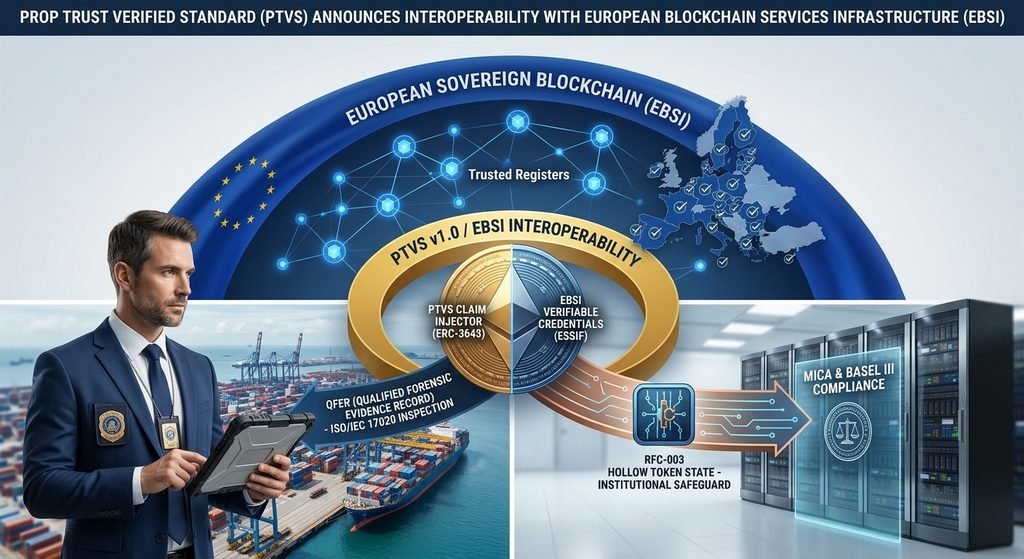
To resolve this, we present the Prop Trust Verified Standard (PTVS) v1.0, a Layer-0 deterministic forensic framework. By combining continuous satellite telemetry (GEE-PTVS), ISO/IEC 17020-compliant human inspections (PTCE), and cryptographic anchoring (SHA-256 + eIDAS 2.0 QES), PTVS transforms physical reality into an immutable, on-chain enforceable truth, natively interoperable with the European Blockchain Services Infrastructure (EBSI).
1. INTRODUCTION: THE $30 TRILLION BLIND SPOT
The global RWA market is projected to exceed $30 trillion by 2030. Institutional capital is flooding into tokenized real estate, infrastructure, maritime assets, and commodities. Yet, a fundamental architectural flaw persists: a smart contract cannot verify the physical state of its underlying collateral.
If a tokenized commercial building suffers severe structural subsidence, or a tokenized vessel is secretly double-pledged in an opaque jurisdiction, the blockchain ledger remains unchanged. The token continues to trade at full value, creating a “toxic token” scenario. The industry has built a flawless digital settlement layer atop a physically unverified foundation.
2. THE ORACLE PARADOX: THE FALLACY OF PURELY FINANCIAL FEEDS
The Web3 industry has rightly celebrated decentralized oracles (e.g., Chainlink, Pyth) for solving the price discovery problem. However, a dangerous conflation has emerged: the assumption that a robust price oracle equates to a robust collateral oracle.
The Paradox: A financial oracle can accurately report that a tokenized real estate asset is “worth” €50M based on market indices. However, it is completely blind to the fact that a local court issued a demolition order for that specific building yesterday, or that environmental sensors detect toxic soil contamination.
For High-Quality Liquid Assets (HQLA) under Basel III (SCO60), collateral must not only be liquid but verifiably sound. Relying on annual, static PDF appraisals or purely financial data feeds constitutes a failure of continuous due diligence, leaving issuers and custodians exposed to severe regulatory sanctions and liability for “omission of physical verification.”
3. THE PTVS v1.0 SOLUTION: LAYER-0 DETERMINISTIC FORENSICS
The Prop Trust Verified Standard (PTVS) v1.0 closes the Physical Oracle Gap by establishing a deterministic, three-pillar Layer-0 forensic infrastructure:
- Continuous Spatial Telemetry (GEE-PTVS): Automated Python scripts interface with Google Earth Engine (utilizing Sentinel-1 SAR and Sentinel-2 multispectral data) to monitor asset coordinates continuously. This detects physical anomalies (e.g., land subsidence, unauthorized construction, environmental degradation) in near real-time, long before they manifest as financial losses.
- Certified Human Forensics (PTCE): When telemetry flags an anomaly, or for initial baseline verification, a Prop Trust Certified Expert (PTCE) conducts a physical inspection under strict ISO/IEC 17020 conformity assessment standards.
- Cryptographic Anchoring (QFER): The findings are serialized into a canonical JSON schema, hashed via SHA-256, and signed with an eIDAS 2.0 Qualified Electronic Signature (QES). This creates a Qualified Forensic Evidence Record (QFER), transforming a traditional expert report into a cryptographically immutable, legally binding digital asset.
4. THE REGULATORY IMPERATIVE: MiCA, BASEL III, AND EBSI
PTVS v1.0 is not merely a technological upgrade; it is a regulatory necessity.
- MiCA (Markets in Crypto-Assets Regulation): Articles 36 and 46 mandate the robust safeguarding of clients’ crypto-assets and reserve assets. PTVS provides the verifiable proof of reserve integrity that regulators demand.
- Basel III (SCO60): Requires banks to hold high-quality, verifiable collateral. A QFER anchored on-chain provides the continuous audit trail necessary to satisfy central bank stress-testing and collateral hair-cutting models.
- EBSI Interoperability: PTVS is explicitly architected to integrate with the European Blockchain Services Infrastructure (EBSI). PTCE accreditations are issued as EBSI-compatible Verifiable Credentials (ESSIF), and QFER hashes are anchored to EBSI Trusted Registers, granting automatic cross-border presumption of authenticity across all 27 EU Member States.
5. THE “OPEN CORE, CLOSED SOVEREIGN” GOVERNANCE MODEL
To accelerate industry adoption, the technical specifications of PTVS v1.0, including reference smart contracts (e.g., RFC003HollowToken.sol for programmatic circuit breakers), are published as open-source under permissive research licenses.
However, PTVS operates on an “Open Core, Closed Sovereign” model:
- The Code is Free: Developers and platforms can integrate the PTVS schema into their ERC-3643 permissioned tokens.
- The Validity is Sovereign: For a QFER to be recognized as legally valid and regulatorily compliant, it must be cryptographically signed by a PTCE whose Decentralized Identifier (DID) is actively accredited and governed by the PropTrust Association, a neutral, non-profit entity domiciled in Zug, Switzerland.
This ensures that while the technology is universally accessible, the standard of truth remains uncompromised, centralized only in the rigorous, audited accreditation of the human experts.
6. CONCLUSION & CALL TO ACTION
The era of “blind trust” in RWA tokenization is over. The Oracle Paradox dictates that without Layer-0 physical forensics, smart contracts are merely automated vehicles for unverified risk.
For Institutional Risk Officers (CROs) & Regulators:
We invite you to request the PTVS HQLA Verification Kit, a comprehensive technical and legal manual detailing how to audit RWA collateral using the PTVS framework to ensure full MiCA and Basel III compliance.
For Judicial Experts, Engineers, and Surveyors:
The future of forensic appraisal is on-chain. We invite qualified professionals to apply for PTCE (Prop Trust Certified Expert) accreditation through the PropTrust Association, joining the exclusive global network authorized to issue QFERs.
REFERENCES & PRIOR ART
This framework and its underlying taxonomy are protected intellectual property, registered to ensure immutable prior art:
- Academic Prior Art (Taxonomy): CERN Zenodo DOI:
10.5281/zenodo.24001234 - Technical Blueprint (GEE-PTVS): CERN Zenodo DOI:
10.5281/zenodo.24031701 - Intellectual Property Registry: Safe Creative No.
2611067566842(SHA-256:e1561a13c15259a5c826d94a5dcc5d0e65c1efdaec95f32dcbd0335fa013ff61) - Open Source Repository:
github.com/aurema-group/prop-trust-verified-standard
Contact: governance@forensics-oracle.org | forensics-oracle.org